


For much of the past decade, the investment case for battery energy storage in Ontario was surprisingly simple.
Install a battery. Reduce your Global Adjustment costs through the Industrial Conservation Initiative (ICI). Generate savings.
For many businesses, that was the entire conversation.
As a result, much of Ontario’s early battery market was built around maximizing Global Adjustment savings. Battery systems were often sized around a narrow objective: capture as many peak hours as possible while minimizing capital cost. In many cases, this led to the deployment of 2-hour battery systems designed almost exclusively around the ICI program.
Today, however, many businesses are questioning whether battery storage still makes sense.
Global Adjustment costs have fallen significantly from their peak in 2020. Some battery projects have struggled to consistently capture all five peak hours. And Ontario’s electricity market looks very different than it did just a few years ago.
At first glance, it may appear that battery economics have weakened. The reality is exactly the opposite. Battery value has not disappeared. It has diversified.
And that diversification may make battery storage a stronger investment today than it was when Global Adjustment was at its peak.
Why Many People Think Batteries Are Less Valuable
The concern is understandable.
At its peak in 2020, a theoretical 1 MW battery could generate nearly $600,000 per year in Global Adjustment savings alone. Today, that number is closer to $200,000 per year.
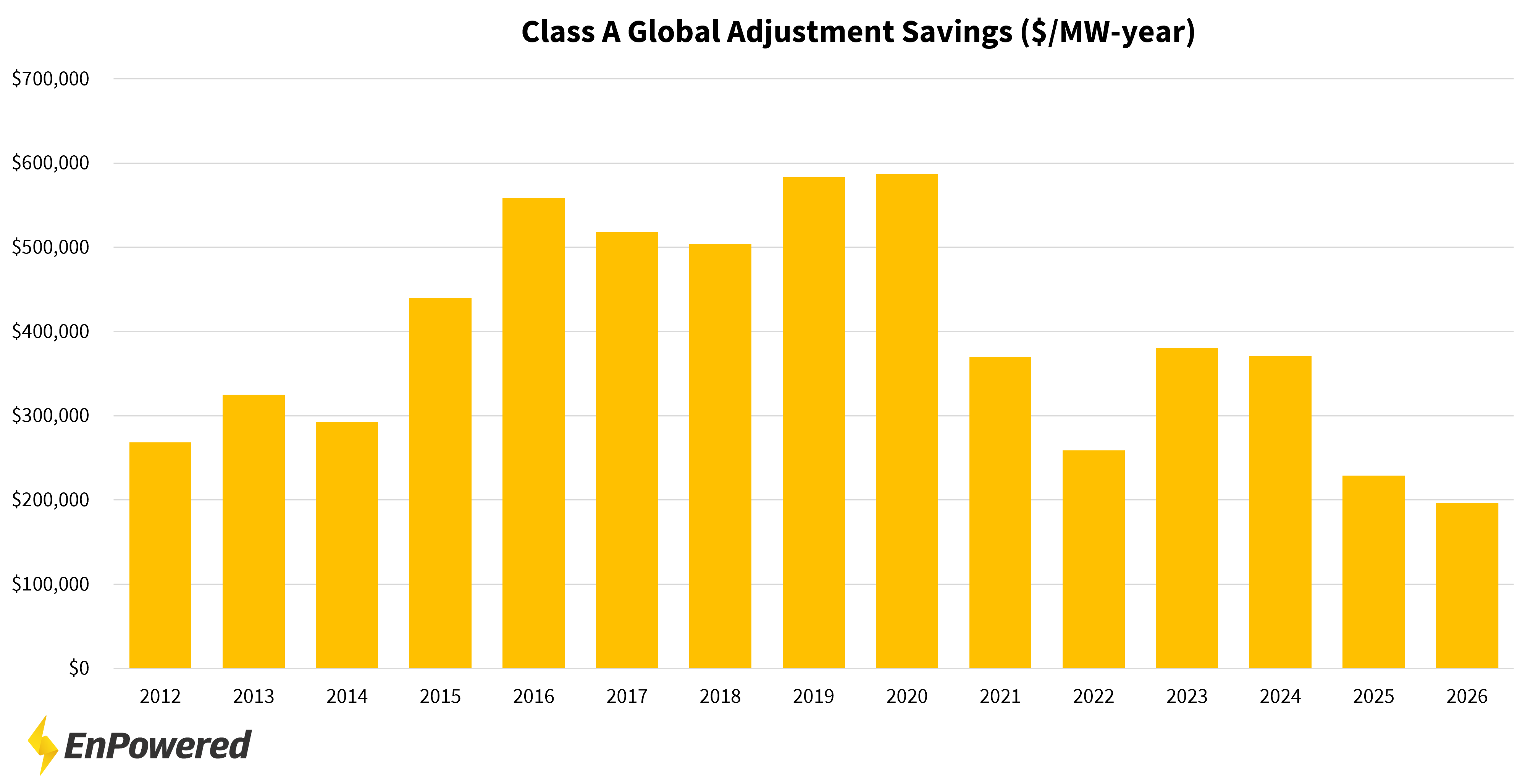
Looking only at Global Adjustment, battery economics appear to have deteriorated dramatically.
But there are two problems with this analysis.
First, it assumes that batteries consistently capture 100% of available Global Adjustment savings. In practice, that has rarely been the case. Many battery projects were designed around 2-hour durations because Global Adjustment was the dominant value stream at the time. Unfortunately, capturing all five annual peaks with a limited-duration battery has proven far more difficult than many expected.
Second, it ignores the fact that Ontario’s electricity market has evolved substantially over the past several years.
The result is that many observers are focusing on the decline of a single revenue stream while overlooking the growth of several others. To understand the true economics of battery storage today, we need to look beyond Global Adjustment.
The Value Didn’t Disappear. It Diversified.
When we adjust historical Global Adjustment values to reflect a more realistic battery performance assumption for a 2-hr system of approximately 75% peak capture, similar to how we’ve seen many batteries perform in the Ontario market over the past decade, a very different picture emerges.
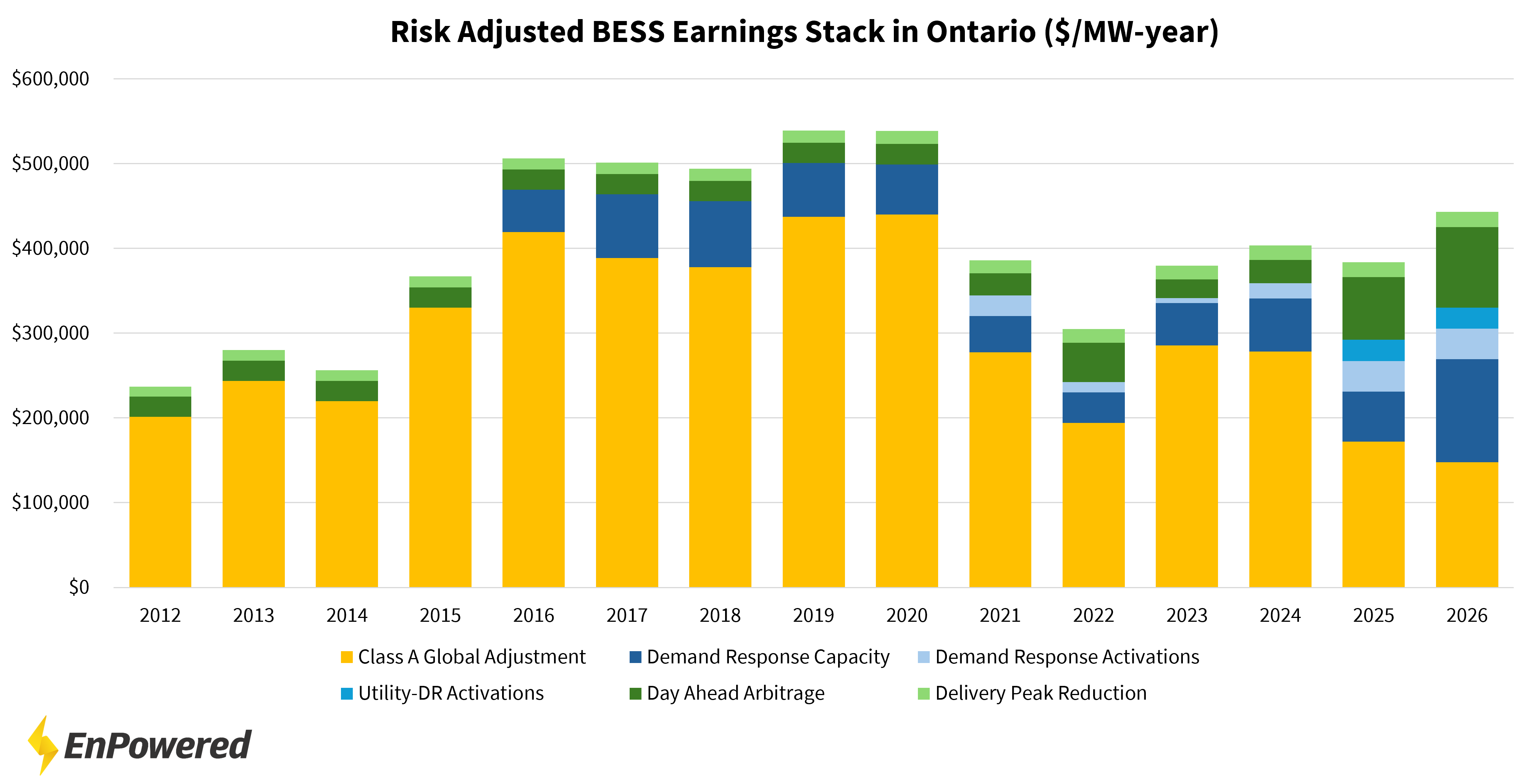
The chart above tells a story that many market participants have missed.
In 2020, the vast majority of battery value came from a single source: Global Adjustment. Even after applying a realistic performance adjustment, roughly 80% of total battery value was still tied to one market mechanism.
That concentration created risk. Miss a peak and revenue suffered. Changes to the ICI program created uncertainty. Future battery economics depended heavily on a single market outcome.
Today, the situation is very different. Global Adjustment remains an important value stream, but it now represents less than one-third of the total value generated by a well-managed battery system.
The rest comes from a growing collection of complementary revenue streams including demand response, activation payments, utility programs, energy arbitrage, delivery charge reductions, and backup power value.
This is exactly what investors typically look for in infrastructure assets. Not dependence on a single source of revenue, but diversified cash flows that remain resilient as markets evolve. Across all of these revenue streams, the total savings available for a 1MW battery remains remarkably stable around $400,000/MW-year despite significant changes in the Ontario electricity market.
Ontario’s Battery Market Has Matured
Perhaps the most important takeaway is that Ontario’s electricity market is becoming more sophisticated.
Historically, batteries were primarily a tool for reducing Global Adjustment costs. Today, they are becoming flexible grid assets capable of creating value across nearly every component of the electricity bill.
Demand Response is a perfect example. Over the past several years, the value of Demand Response capacity payments has increased substantially. At the same time, the IESO has expanded procurement targets and increased price caps, signaling a growing need for flexible resources that can support grid reliability.
Demand Response Activation payments have also become increasingly meaningful as the grid experiences tighter supply-demand conditions and operators call on flexible resources more frequently.
Utilities are moving in the same direction. Utility-based Demand Response programs such as GrandBridge’s recently announced demand response initiative represent another example of utilities recognizing the value of flexibility at the local distribution level. While these programs remain relatively new, they point toward a future where batteries can participate in multiple layers of the electricity system simultaneously.
Commodity savings have followed a similar trend. The introduction of Day-Ahead pricing in May 2026 and increasing market volatility have created significantly larger arbitrage opportunities than existed only a few years ago. While commodity prices fluctuate, the long-term trend toward a more dynamic electricity market is creating more opportunities for flexible assets to generate value.
Even delivery savings continue to grow steadily over time. Delivery charges have increased by 2.9% annually for roughly the last 20 years and represent a stable value stream that is largely independent of market volatility.
Viewed individually, each of these opportunities may seem modest. Combined, they fundamentally change the investment case for battery storage.
The Same Trends Increasing Battery Value Are Increasing The Need For Backup Power
There is another important trend that often gets overlooked. The same market conditions that are increasing the value of flexible assets are also increasing the importance of resiliency.
Ontario’s electricity system is becoming more constrained. Demand is growing. Electrification is accelerating. New generation takes years to build. Extreme weather events are becoming more frequent. Grid operators are increasingly relying on flexible resources to maintain reliability during periods of stress.
These conditions create more opportunities for batteries to participate in energy markets. They also increase the value of having reliable backup power.
Historically, businesses often viewed resiliency as a cost center. Backup generators and other emergency systems provided insurance against outages but generated little financial return.
Battery storage changes that equation. The same asset that generates revenue throughout the year can also provide critical backup power during outages and grid disruptions.
In other words, the business case for resiliency and the business case for market participation are increasingly becoming the same thing.
Flexible Assets Are Becoming Essential Grid Infrastructure
The broader lesson is that Ontario’s electricity system is changing.
Ten years ago, batteries were largely a strategy for reducing Global Adjustment. Today, they are becoming an essential piece of grid infrastructure.
As renewable generation continues to grow, electrification accelerates, and grid constraints become more pronounced, the value of flexibility will continue to increase. While no one can predict exactly how individual markets will evolve, the long-term trends remain remarkably consistent.
Delivery costs continue to rise. Wholesale electricity costs continue to grow. Demand response procurement continues to expand. Utilities continue to seek flexible resources. And businesses continue to place a premium on resiliency.
All of these trends point in the same direction. The future grid will require more flexibility, not less.
Bottom Line
The old battery thesis is no longer enough.
While Global Adjustment remains an important component of battery economics, it is no longer the primary driver of value. Ontario’s electricity market has matured, creating multiple complementary revenue streams that reward flexibility across the entire electricity bill.
As a result, battery storage is no longer a bet on a single program. It is a diversified infrastructure asset capable of generating value from multiple markets while simultaneously providing resilient backup power.
For businesses that value resiliency, energy cost reduction, or long-term sustainability, battery storage deserves serious consideration. Not because of any one market opportunity, but because flexibility itself is becoming increasingly valuable.
At EnPowered, we help businesses capture that value by combining battery storage with sophisticated energy market participation. The result is often a battery project that delivers meaningful resiliency and financial returns without requiring customers to become electricity market experts themselves.

Related Resources