


Ontario’s Global Adjustment (GA) prices have had an unusually volatile start to 2026.
During the winter months, GA prices dropped to exceptionally low levels – even turning negative for a few months. This was driven primarily by extremely high commodity prices during the cold winter period, which offset a larger portion of total system costs than normal.
At the time, this raised an important question across the industry: had Ontario’s electricity market fundamentally changed? If commodity prices remained elevated and increasingly volatile, could Global Adjustment continue trending materially lower over the long term?
So far, however, the market appears to be returning toward more familiar patterns.
After the sharp decline earlier this year, GA prices have now rebounded back to levels much more consistent with historical averages.
Comparing 2026 to Historical Trends
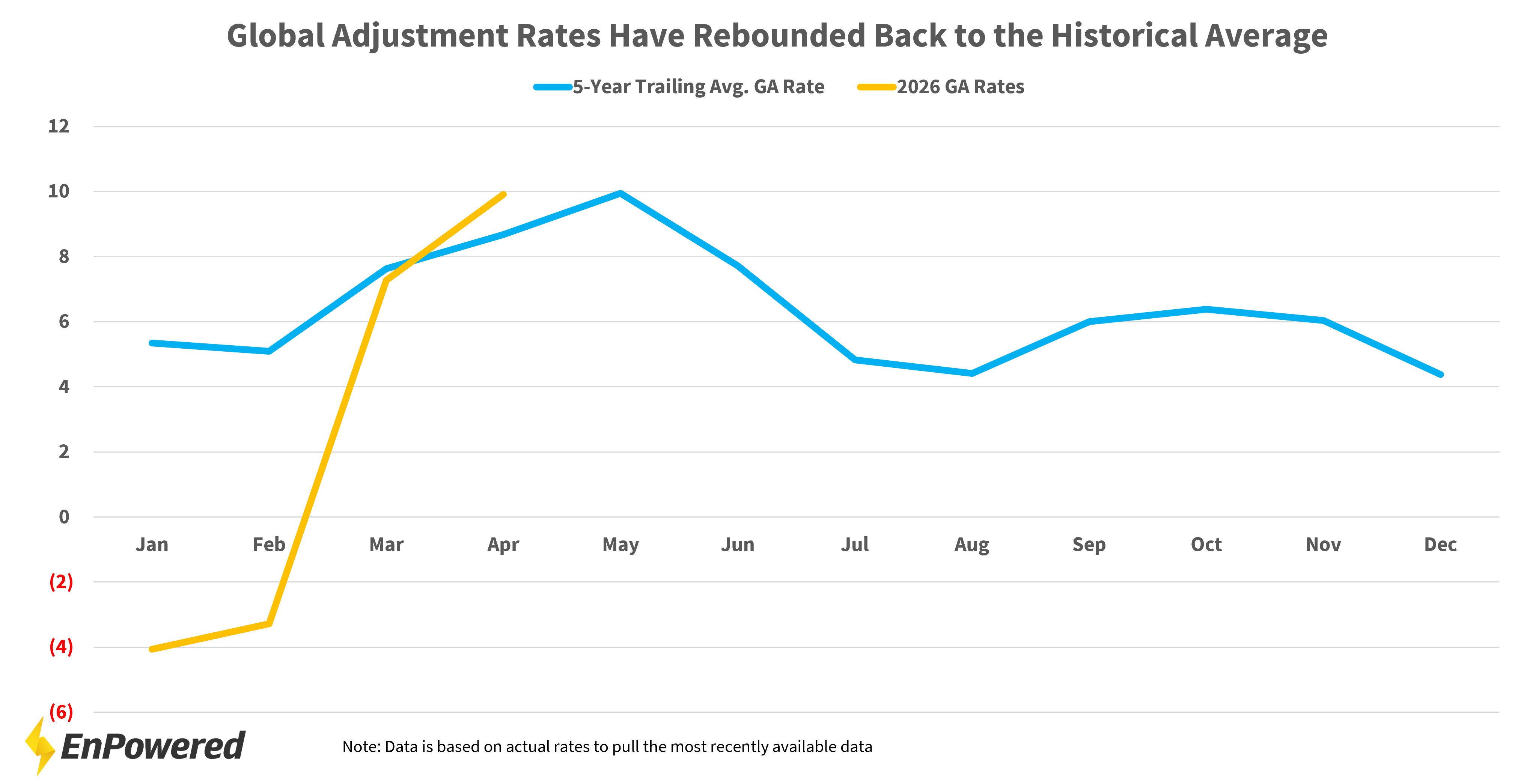
The chart above compares actual monthly GA rates in 2026 against the trailing 5-year monthly average (note that we are using actual GA rates in order to access the most recent data, we are not using 1st estimates of GA).
The divergence earlier this year was significant:
- January: historical average 5.4¢/kWh vs a 2026 actual -4.1¢/kWh
- February: historical average 5.1¢/kWh vs a 2026 actual -3.3¢/kWh
By March and April, however, GA had already returned to much more typical levels:
- March: historical average 7.6¢/kWh vs a 2026 actual 7.3¢/kWh
- April: historical average 8.7¢/kWh vs a 2026 actual 9.9¢/kWh
While the first two months of the year were highly unusual, the market has since moved back toward the same seasonal pattern Ontario has experienced historically.
This suggests that the underlying fundamentals of Global Adjustment remain largely intact, even if short-term volatility has increased.
What Is Driving the Increased Volatility?
The primary driver behind this year’s unusually low GA values was the sharp increase in commodity prices during the winter.
Ontario’s electricity market is structured such that Global Adjustment effectively acts as a balancing mechanism. When commodity prices rise, a larger portion of generator compensation is recovered directly through the market, reducing the amount that must be collected through GA.
This winter created a near-perfect environment for that effect:
- Very cold weather increased demand
- Tight supply conditions due to plant refurbishments caused us to rely on more expensive generators more often
- Commodity prices surged for extended periods of time
As a result, commodity prices were very high and GA dropped dramatically.
What is important, however, is that this does not necessarily mean overall electricity system costs have materially declined. Instead, the recovery of those costs temporarily shifted from Global Adjustment into the commodity market. You can read more about what caused this commodity price spike in this article here.
This distinction matters because it helps explain why GA rebounded so quickly once market conditions normalized.
The Market Structure Hasn’t Fundamentally Changed
While this winter’s pricing was unusual, the broader structure of Ontario’s electricity market remains largely the same.
The province still expects:
- Long-term generation contracts
- Nuclear refurbishment investments
- Transmission infrastructure spending
- Capacity and reliability programs
- Continued electrification growth
These costs still exist and still need to be recovered through the electricity system over time.
What does appear to be changing is the variability of pricing.
As Ontario experiences more extreme weather events and increasing market volatility, we are likely to see larger swings between commodity and Global Adjustment pricing. During periods of very high commodity prices – particularly during hot summers or cold winters – GA may periodically fall to unusually low levels again.
However, the extreme lows we saw this winter are unlikely to become the norm every year. Instead, the more likely outcome is a continuation of the broader historical pattern:
- Higher GA during spring and fall shoulder months
- Lower GA during peak summer and winter periods
But with more volatility around those seasonal trends.
What This Means Going Forward
For businesses managing electricity costs, the key takeaway is that Global Adjustment is not disappearing.
While average GA costs may trend somewhat lower compared to historical norms as commodity prices become a larger component of total electricity costs, GA is still expected to remain a major portion of Ontario electricity bills.
Larger Class A customers typically think about GA in terms of an annualized $/MW-year cost rather than a monthly per-kWh rate. So, to better understand what this new pricing environment could mean in practice, we recreated the previous chart using the equivalent monthly cost of maintaining 1 MW of Class A demand.
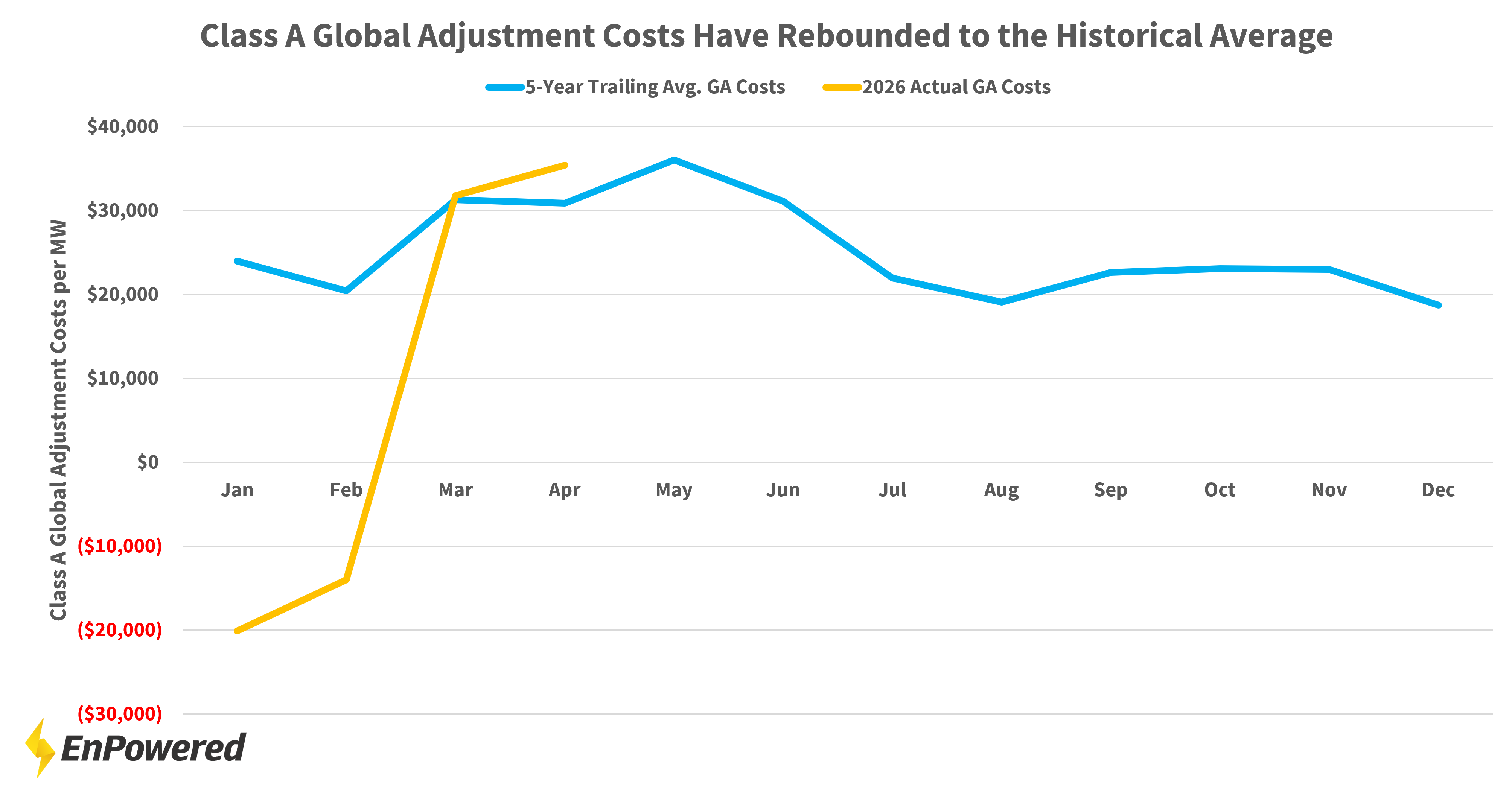
Unsurprisingly, the chart shows the same overall relationship as before: after collapsing earlier this year, GA costs quickly rebounded back toward historical averages. However, this framework also allows us to estimate what costs could look like in a more volatile commodity market moving forward.
Let’s assume that commodity prices continue to spike during periods of extreme weather – particularly during peak winter and summer months. In that scenario, GA would likely continue following the same pattern we observed this year:
- Lower GA during high-priced summer and winter months
- Higher GA during shoulder months as commodity prices normalize
Using the 5-year historical average as a benchmark, and then applying conservative reductions during peak seasonal months, we can speculate what annualized Class A costs may look like in this environment.
Even under these relatively aggressive assumptions, total annual Class A GA costs still reach approximately $190K/MW-year.
| Month | 5-Year Rolling Avg. Class A GA Costs ($/MW) | Assumed Ratio | Assumed Future Class A GA Costs ($/MW) |
| Jan | $23,984.55 | 0% | $0.00 |
| Feb | $20,450.50 | 25% | $5,112.62 |
| Mar | $31,302.30 | 100% | $31,302.30 |
| Apr | $30,911.97 | 100% | $30,911.97 |
| May | $36,068.31 | 100% | $36,068.31 |
| Jun | $31,126.65 | 25% | $7,781.66 |
| Jul | $21,949.99 | 0% | $0.00 |
| Aug | $19,103.07 | 25% | $4,775.77 |
| Sep | $22,648.51 | 100% | $22,648.51 |
| Oct | $23,102.26 | 100% | $23,102.26 |
| Nov | $22,987.60 | 100% | $22,987.60 |
| Dec | $18,735.52 | 25% | $4,683.88 |
| Total | $302,371 | $189,375 |
This means businesses should continue planning around:
- Meaningful Global Adjustment exposure
- Seasonal pricing patterns
- Increased short-term volatility
At the same time, increased volatility is also increasing the value of flexibility. Technologies such as battery storage, demand response, and load shifting become more valuable as market swings grow larger and less predictable.
The structure of Ontario’s electricity market may be becoming more dynamic, but the need for flexibility – and the value it provides – is only increasing.
Bottom Line
The first few months of 2026 were highly unusual for Ontario electricity markets.
Exceptionally high winter commodity prices caused Global Adjustment to temporarily collapse to historic lows. But only a few months later, GA prices have already rebounded back to historical norms.
The broader pattern remains familiar:
- Lower GA during peak summer and winter conditions
- Higher GA during shoulder months
- And total annual system costs that still need to be recovered over time
While volatility is increasing, the underlying fundamentals of Ontario’s electricity market remain largely unchanged.
Global Adjustment may fluctuate more dramatically moving forward – but it is still very much here to stay.