


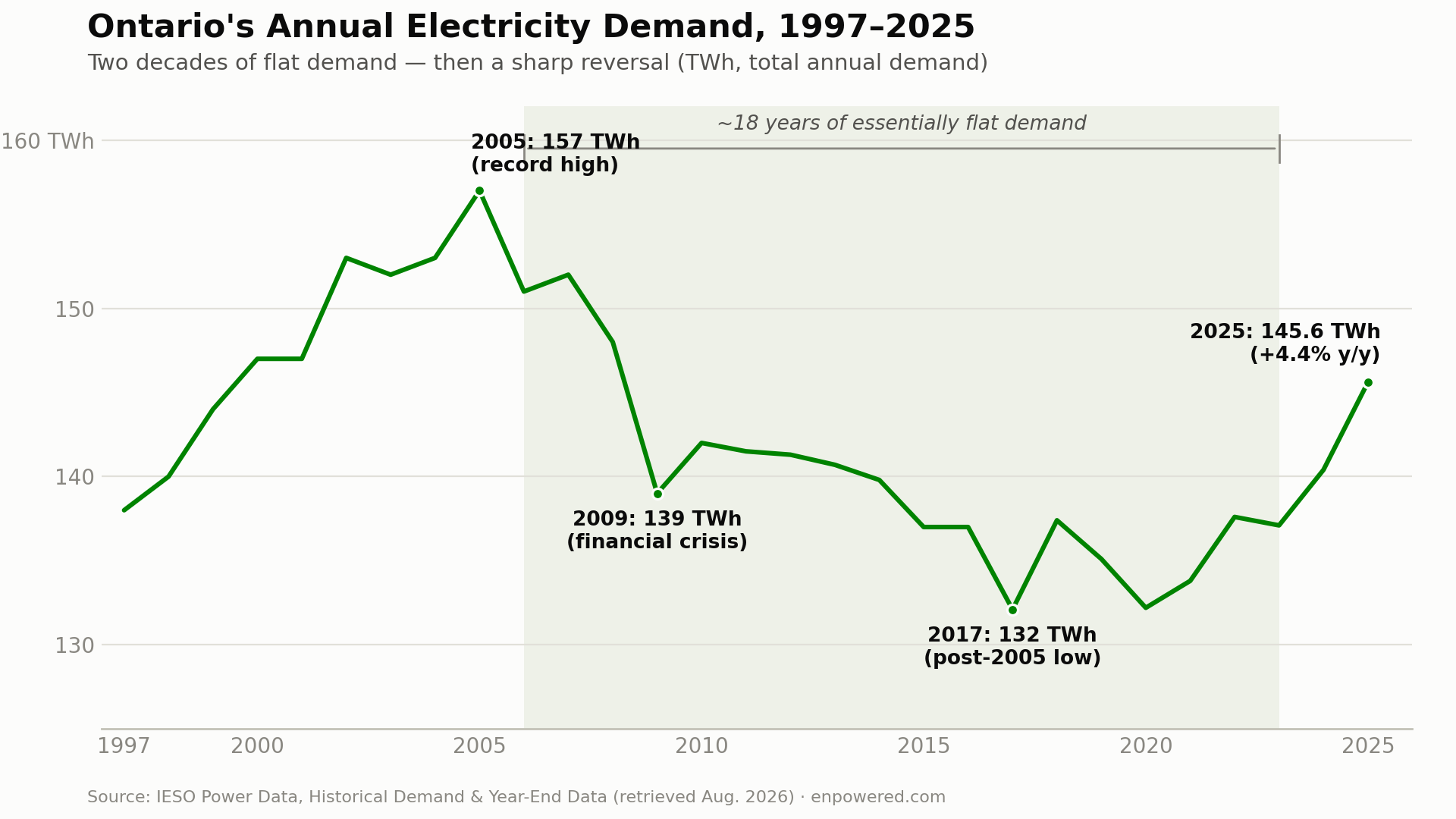
For nearly two decades, Ontario’s grid operators had a relatively easy job when it came to demand. Total annual electricity demand hit a record 157 TWh in 2005, and then didn’t get close to that number again for almost twenty years. It dropped through the 2008-09 financial crisis, hovered in a narrow band through the 2010s, dipped again during the pandemic, and didn’t meaningfully start growing out of that range until 2022. Planners could look at next year’s demand and expect something close to this year’s.
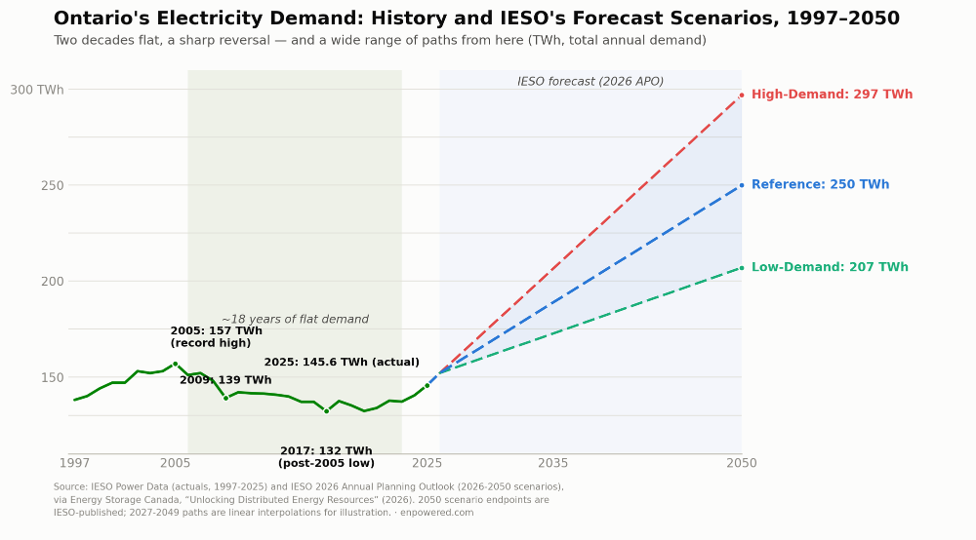
That era is over. Demand has grown for four straight years, hitting 145.6 TWh in 2025 – the highest since 2005 – and the IESO now projects it will grow another 65% by 2050, to 250 TWh, with system peak climbing from roughly 23 GW today to 27 GW by the early 2030s.
A perfect storm, not a single trend
It’s tempting to point at one cause for this reversal. There isn’t one. Ontario is being hit by several structural shifts at the same time, and they’re compounding rather than offsetting each other.
Reindustrialization is bringing manufacturing capacity back to the province – supply chain plants, steel retooling, and broader reshoring as companies rethink long, fragile overseas supply chains in favour of production closer to home. Electrification is adding load in parallel: heat pumps displacing gas furnaces, EVs displacing gas tanks, and industrial processes converting from combustion to electric heat. And now data centres are layering a third, faster-moving source of demand on top of both. As of August 2026, the IESO is tracking roughly 7,000 MW of data centre-related connection requests in the province – more than double what was reported back in March, and over a quarter of Ontario’s entire peak demand, most of it still in the early stages of development.
Any one of these drivers alone would be a meaningful planning challenge. Together, they’re why the IESO now splits its demand forecast into a stable baseline and a “growth margin” – the portion driven by data centres, industrial electrification, and EV and building adoption that’s genuinely uncertain in timing, location, and scale. That margin already accounts for up to 27% of total projected 2050 demand, and it’s why the gap between the IESO’s high- and low-demand scenarios has widened to a full 90 TWh by mid-century.
This is genuinely good news for Ontario – it’s what a growing, competitive, reindustrializing economy looks like. But it means the grid has to absorb several large, only partly-predictable sources of new demand at once, on a timeline it doesn’t fully control.
The policy bind: cheap power is the goal and the magnet
Underneath the demand numbers sits a harder policy tension. Keeping electricity costs low isn’t optional for Ontario – energy costs flow into the price of nearly everything else in the economy, and affordable power has long been one of the most direct levers governments have for keeping cost-of-living pressure and broader inflation in check. That’s not a nice-to-have. It’s a core piece of economic policy.
But cheap, reliable power is also exactly what attracts the reindustrialization, electrification, and data centre investment described above. Low electricity costs are a competitive advantage that draws in the kind of large industrial and digital infrastructure investment every jurisdiction is currently competing for. That’s the bind: the very success of keeping costs low is what pulls in enough new demand to make costs harder to keep low. Ontario’s December 2025 Capacity Auction is an early signal of that pressure showing up in practice – it cleared 188% above the prior year, at the highest prices since the auction began, and still fell short of its winter procurement target. System operators are now trying to do two things that pull against each other: deliver reliable cheap electricity costs to attract growth and reduce political pressure, while keeping those electricity costs low even after attracting all of that additional demand.
It’s not just about price – it’s about margin
That pricing pressure is a visible symptom of something more fundamental: the physical grid is running with less room to spare, in electrons, not just in dollars.
Ontario’s 2024 load factor – average electrical demand relative to peak demand – was already 67%, with average demand running roughly 8 GW below the annual peak. As demand grows faster than new generation and transmission can be built, that buffer shrinks further. Pickering Nuclear’s remaining units retire at the end of 2026, removing about 2.1 GW of baseload capacity right as demand accelerates, and under the IESO’s own scenarios, Ontario’s capacity deficit could exceed 25 GW by 2050 in a high-demand future.
A tighter margin changes how the grid behaves, not just what it costs. Operating with less buffer means less room to absorb a generator tripping offline, a transmission line going down, or a heat wave and a cold snap both landing harder than forecast. And those events are becoming more frequent, not less – severe weather has been showing up more often and more intensely across the systems Ontario’s grid depends on. A system with ample headroom shrugs off a bad week. A system running close to its limits is far more exposed to the same event, at exactly the moment more of the economy is depending on it staying up.
Why behind-the-meter batteries matter more from here
Meeting this moment requires more generation, more transmission, and more flexibility – all at once. The demand is coming back now, and coming back rapidly, while growing supply takes years – even decades. New nuclear, transmission, and long-term generation contracts are underway and necessary, but they typically take five or more years to move from approval to commissioning. Distributed battery storage is one of the few resources that can move faster: batteries already installed across Ontario’s commercial and industrial sector can be enrolled and dispatched within a 12- to 24-month window, without a single new transmission line, adding real capacity and flexibility to a system that needs both.
For a business, that’s also where the opportunity sits. A behind-the-meter battery does two things for the same asset, at the same time. It future-proofs your own operations against a grid that’s increasingly exposed to disruption – outages, price spikes, and tightening supply during the exact hours the rest of the system is under the most stress. And it gets paid for doing so: participating in demand response, capacity, and energy markets to generate real revenue from the flexibility the battery provides, rather than letting that capability sit idle. As the grid gets more constrained, both halves of that value proposition – protection and payment – are positioned to grow, not shrink. The businesses that put this flexibility in place now, ahead of the next tight summer or the next severe winter storm, are the ones positioned to capture that upside as it builds.
Ontario’s growth story is a good one. The businesses and communities driving it – including the data centres now queued up at the IESO – are a sign of real momentum. But momentum on this scale doesn’t wait for the grid to catch up on its own, and the margin for error is shrinking as it builds. The batteries capable of adding capacity and resilience to that system are being built today. What’s left is putting them to work.

Related Resources