Ontario’s electricity system has been running out of slack for more than a year. Last December’s capacity auction cleared at the highest prices in its history and still fell short of its winter target. The past few weeks have added more signs of the same trend: Pickering’s four “B” reactors came offline for refurbishment, the IESO signed a short-term deal to import 600 MW from New York for this winter, and it raised its targets for next month’s auction.
For businesses, a tighter system cuts both ways. It raises the risk of expensive commodity prices during the winter, and it raises what the grid will pay for flexibility. Below, we break down both sides, and explain why capturing the opportunity takes more than reducing load during demand response (DR) windows.
Ontario’s Capacity Surplus Is Over
For most of the past decade, Ontario had more generating capacity than it needed. Capacity was cheap, imports were dependable, and the annual auction bought what the IESO asked for at modest prices.
That cushion is gone. Demand is growing, a large share of the nuclear fleet is offline for refurbishment, and neighbouring markets are tight too, which makes imports a less reliable backstop. When a system has little spare capacity, small changes, such as a maintenance request or a colder-than-expected week, start to matter a lot more.
The IESO’s recent decisions reflect that. Rather than relying on the auction alone, it went outside the competitive process to contract imports for this winter, including from an oil-fired generator in New York. The era of long-term capacity surpluses in Ontario is officially over.
This isn’t a one-time event. It’s the continuation of a trend that started more than a year ago.
| When | What happened | Why it matters |
|---|---|---|
| Oct 2026 | IESO raises its 2026 auction targets by 200 MW, to 2,000 MW for summer 2027 and 1,400 MW for winter 2027/28 | More capacity is needed next year, not less |
| Oct 2026 | IESO contracts 600 MW of imports from New York for winter 2026/27 | The auction alone couldn’t meet the need in time |
| Sep 2026 | Pickering “B” units 5 to 8, about a tenth of Ontario’s electricity, come offline until 2031 to 2034 | A large block of baseload supply is gone for years |
| Jun 2026 | IESO cuts assumed imports from 2,000 MW to 1,800 MW and flags a Darlington outage in April 2027 | Neighbouring markets are tighter too |
| Dec 2025 | Capacity auction clears at record prices and procures 1,125 MW of winter capacity against a 1,200 MW target | The first clear price signal of scarcity |
Another Tight Winter Means a Risk of High Commodity Rates
Last winter showed what a tight system costs. From November through February, Ontario’s monthly market price ran at roughly double the rest of the year, and January set the highest monthly wholesale price since Ontario’s market opened in 2002.
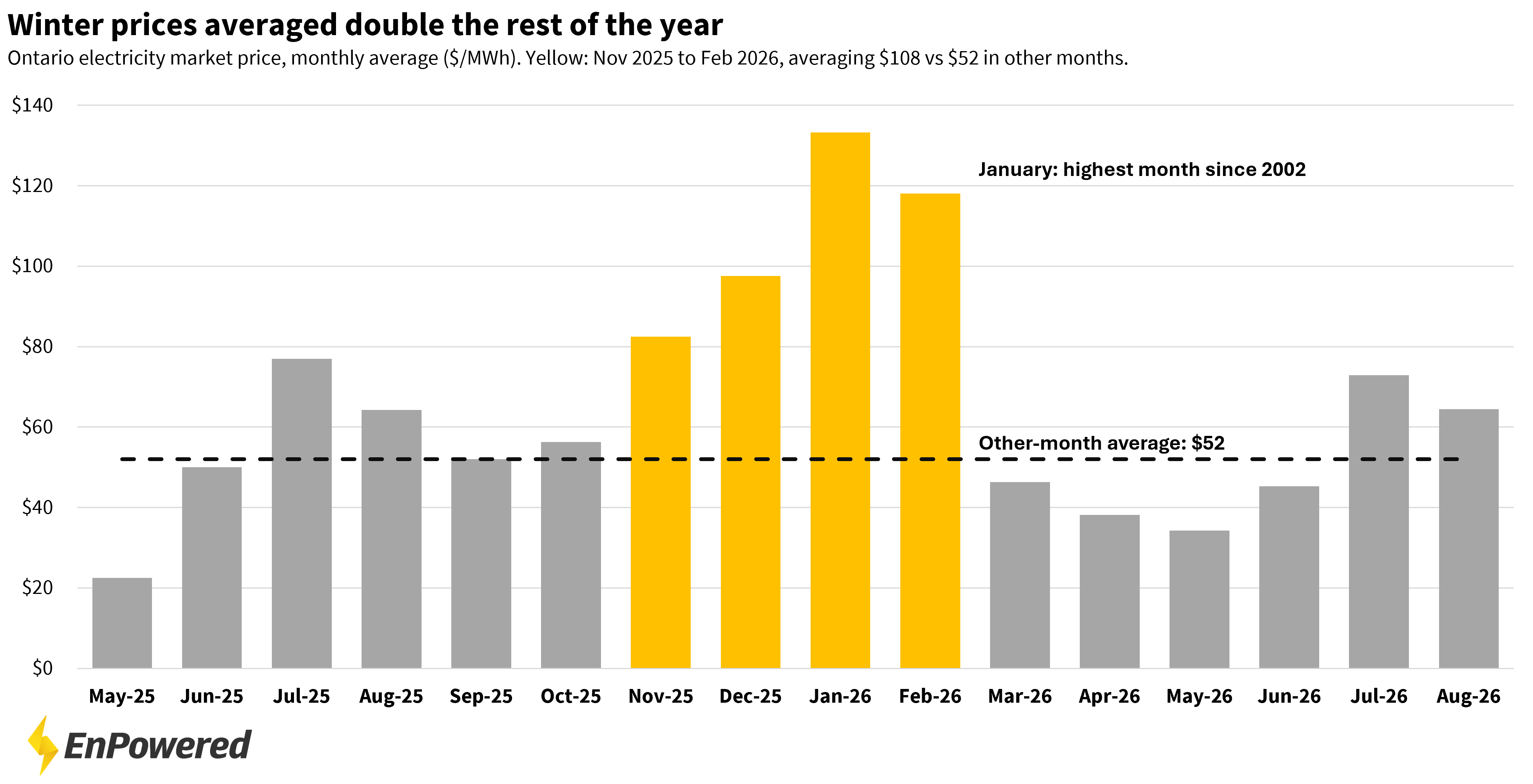 Cold weather was the trigger, but it wasn’t only Ontario. Extreme cold across eastern North America tightened every neighbouring market at once, and Ontario’s price followed. In fact, the single most expensive hour of January came at a demand level well below Ontario’s typical summer peaks.
For Class A customers, part of that cost came back through Global Adjustment (GA), which turned negative in January and February (as we explained in April). But the offset isn’t one-for-one. Your GA share is set by your Peak Demand Factor, while commodity is charged on every kWh you consume. For facilities with heavy winter consumption, the net result was still an expensive winter.
This winter should be gentler. A strong El Niño has most seasonal outlooks leaning milder than normal for southern Ontario. But milder isn’t the same as safe. With Pickering offline and less spare capacity than a year ago, the system has less room to absorb a cold snap, and a few cold weeks are enough to create very expensive hours.
We don’t expect a repeat of last January. We do expect the price risk in any cold stretch to be higher than it was a few years ago.
The Same Scarcity Is Raising the Value of Flexibility
Scarcity has an upside for businesses that can adjust their consumption. When the system is short on capacity, the IESO has to pay more for resources it can count on during tight hours, and demand response is one of the lowest-cost options it has.
Last year’s auction made that clear. For several years, the annual value of capacity sat in a fairly narrow band. The December 2025 auction nearly tripled it, and for the first time, winter capacity cleared at a higher price than summer.
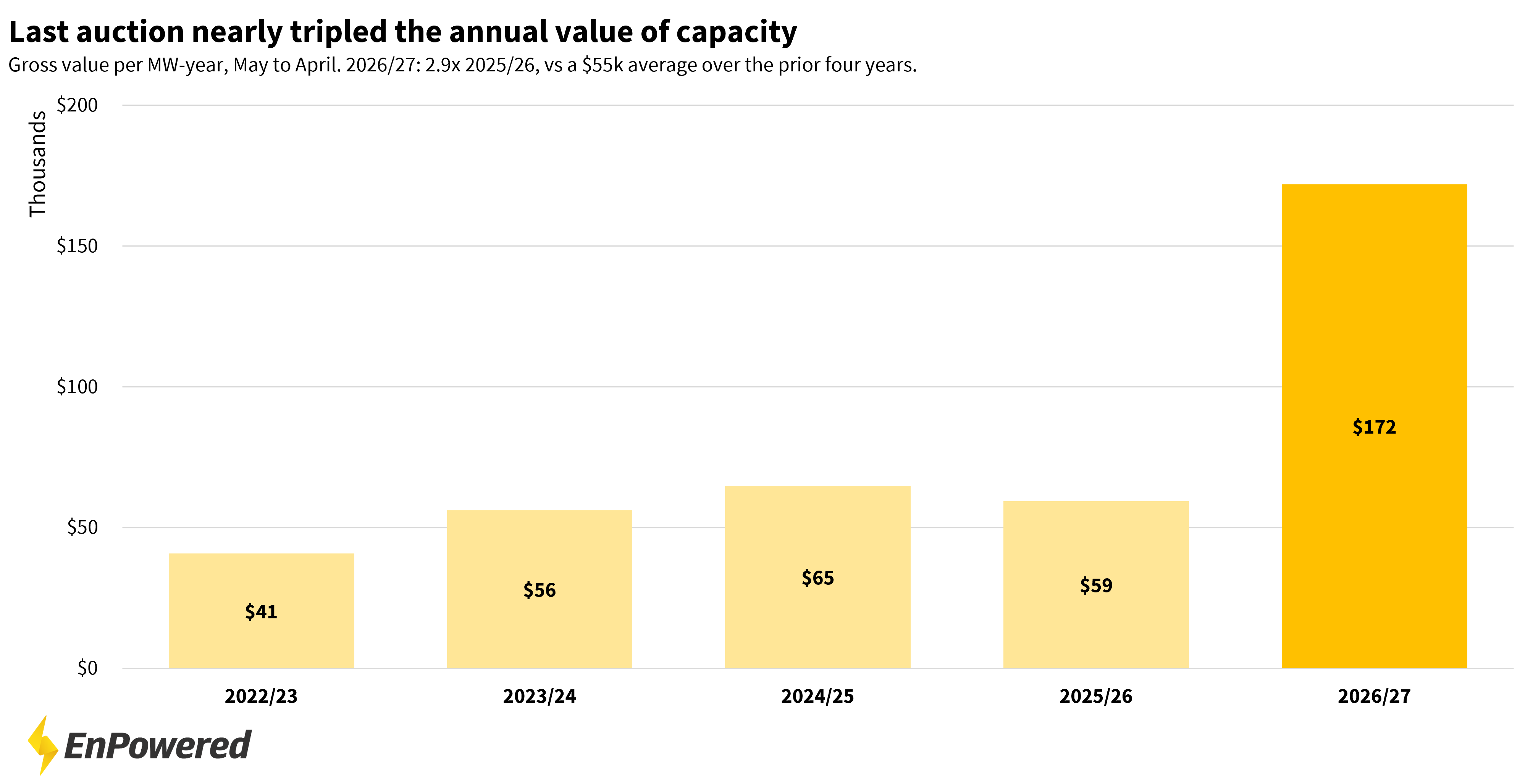
The 2026 auction runs November 25 to 26, and the conditions behind last year’s result haven’t gone away. Targets are higher, Pickering is offline, and the IESO has already shown it is willing to go outside the auction to find supply. All of that points toward another strong year for DR value.
It isn’t guaranteed. Battery storage on Ontario’s grid has more than tripled since last summer, and those batteries compete for the same capacity. More competition could temper prices even as the need grows, so we’ll be watching the results closely.
The Risk and the Opportunity Don’t Sit in the Same Hours
At first glance, one strategy seems to address both sides: reduce consumption when the grid is tight. In practice, the hours that cost the most and the hours that pay are only partly the same.
Demand response capacity can only be called within a fixed availability window. In winter, that window runs from 4 p.m. to 9 p.m. EST on business days. Winter prices, however, spike around two different demand peaks, one in the morning as buildings heat up and operations start for the day and one in the evening when homeowners come home from work.
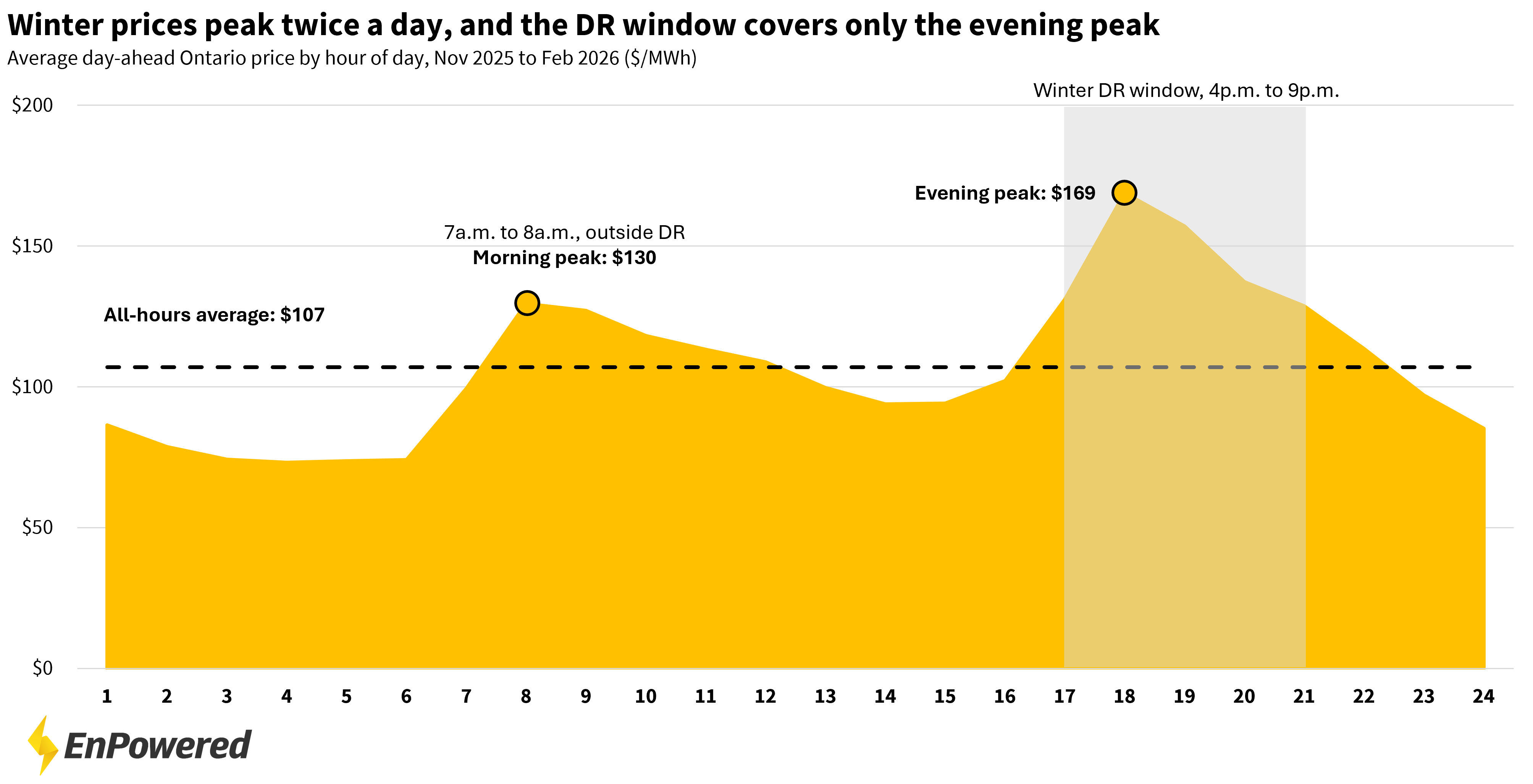
The evening peak sits inside the DR window. The morning peak sits entirely outside it. A facility that is only able to respond to DR activations has no reason to change anything at 8 a.m., which is exactly when winter prices first spike.
Last January shows the gap clearly. The two most expensive hours of the month landed on opposite sides of the day:
| Hour (EST) | Real-time Ontario price | Inside the winter DR window? |
|---|---|---|
| Saturday, January 24, 8 to 9 a.m. | $1,327/MWh | No |
| Tuesday, January 6, 6 to 7 p.m. | $1,031/MWh | Yes |
For context, January had 167 hours priced above $200/MWh, and February had another 119. Those hours don’t all fall inside the DR window. The January 24 spike, for example, came on a weekend morning.
A facility that is able to curtail during DR windows earns capacity revenue but stays exposed to everything else. Capturing both sides takes flexibility across more of the day. That can come from shifting operations, from on-site battery storage, or from both.
Batteries are well suited to this. A battery can discharge through a morning price spike, recharge midday when prices are lower, and still be ready for a DR activation in the evening, since activations last at most four hours and occur at most once a day. It’s the same stacking logic we covered in our June article on battery earnings.
Bottom Line
Ontario has moved from surplus to scarcity, and this fall’s developments confirm a trend rather than start one. For Class A facilities, that means more exposure to commodity spikes in cold weather, even in a milder winter, and more value in being flexible.
The catch is that the hours that cost you and the hours that pay you only partly overlap. The businesses best positioned for this market are the ones that can respond across the whole day, not just during DR windows.
If you want to understand what tighter supply means for your facility’s costs, or what your flexibility could be worth ahead of November’s auction, our team is here to help.

Related Resources